Cookies
Only with your okay.
We’d like to use statistics and marketing services (Google Analytics, Google Ads, Meta, LinkedIn, SalesViewer) to improve our website and our advertising. That only happens if you agree. More in the privacy policy.
Cookies
Only with your okay.
We’d like to use statistics and marketing services (Google Analytics, Google Ads, Meta, LinkedIn, SalesViewer) to improve our website and our advertising. That only happens if you agree. More in the privacy policy.
Sustainability
•
4 min
Lived Sustainability or Greenwashing? – When Is a Company Sustainable?
Lived Sustainability or Greenwashing? – When Is a Company Sustainable?
Lived Sustainability or Greenwashing? – When Is a Company Sustainable?
In a world where more and more companies claim to be CO2 neutral or to want to become so, we as a marketing agency see, unfortunately all too often, that not everything that glitters is really green. We often see …
In a world where more and more companies claim to be CO2 neutral or to want to become so, we as a marketing agency see, unfortunately all too often, that not everything that glitters is really green. We often see …

by Olivia Ulbing-Sommeregger

What is ESG?
ESG stands for environmental, social and governance – three pillars that together form the backbone of truly sustainable corporate management. They show that real sustainability goes beyond recycling paper and has to be deeply embedded in a company’s ethics.
Environmental: This pillar refers to a company’s ecological footprint, including its use of resources and waste production.
Social: This is about the wellbeing of employees and of the community the company affects.
Governance: Governance deals with corporate management, ethics and transparency.
Without really thinking about it, I implemented sustainability at oha! from day 1 & led by example, because somehow I was already aware that this planet’s resources aren’t infinite. And let’s be honest, wouldn’t you also want to build on something that isn’t rotten from the inside? That goes for companies as well as for the environment we live in.
Is oha! a sustainable company?
Let me say this up front – yes and no. Through the insights from the ESG course I’m currently attempting, I realised that oha! already does some things very well, without me having agonised for weeks over what we could do for more sustainability in the company. We’re definitely not yet where I want to be, but I’m already very proud of the foundation we’re building on.
oha! is basically a paperless agency, but since we know our invoices often get printed for accounting, we donate a tree to the Plant for the planet project for every invoice we send. You too can support our reforestation project in Ghana here and donate trees.
We separate our waste strictly and avoid plastic wherever we can. We mainly buy our technical devices second-hand and rely on electric mobility or use public transport with the Klima Ticket. When the weather allows, we also like to cycle to and from the office.
The physical and mental health of my team members is especially important to me. We support that through flexible working hours and the option to work remotely.
Where we still struggle is in assessing the energy resources we use, because our office setup gives us no insight into how much electricity, water or district gas for heating we consume. I also want to find out how much waste in kg we really produce and send for recycling. I’m also trying to find out exactly where our data is hosted and how much energy our work uses there. This consumption is often overlooked at online agencies in particular, but it’s part of the real total. The oha! website, at any rate, does okay on carbon consumption, though with clear potential for improvement. Working on it!
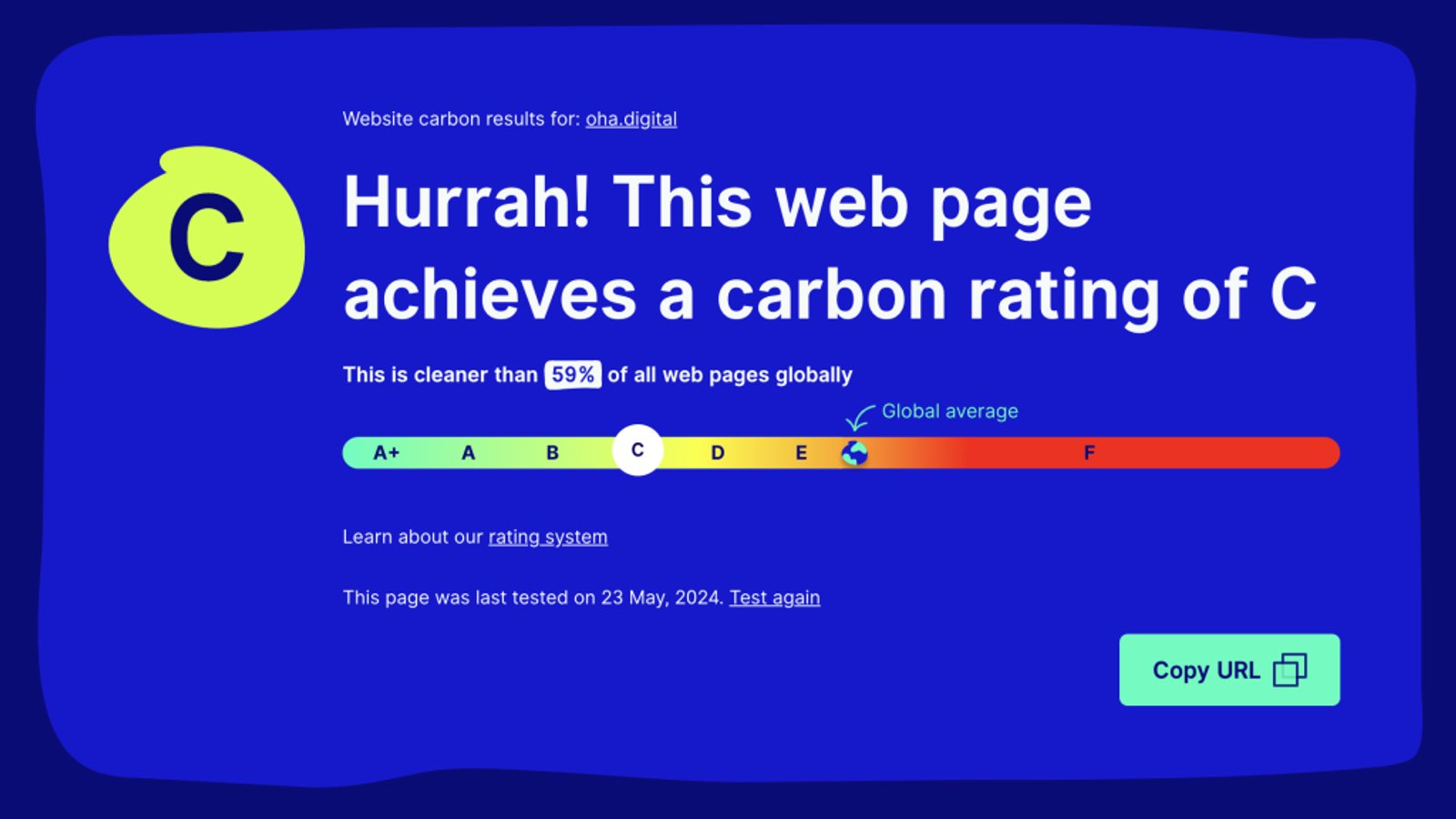
Only once you spend more time on resource management do you notice everything you could and should pay attention to, so my next goal for oha! is to produce a voluntary ESG sustainability report, even though as a small digital studio we wouldn’t be required to report yet.
What can other companies do for sustainability?
A company can only reach its sustainability goals if they’re authentic and deeply anchored in the company culture. Instead of superficial actions, what’s needed is structured measures that create real change.
From 2025, many companies in Europe will be required to submit ESG reports. So it’s smart not to wait until 2025 but to start with sustainable measures now. That strengthens not only your reputation but also your internal structure and the wellbeing of everyone involved.
Sustainability affects not only the environment but also employee satisfaction. A valued employee stays loyal to the company and actively contributes to its success. In a sector with a shortage of skilled workers, this could be the key to winning and keeping top talent.
So is that greenwashing?
A few days ago I got this message on LinkedIn. Sounds like a great deal, doesn’t it?
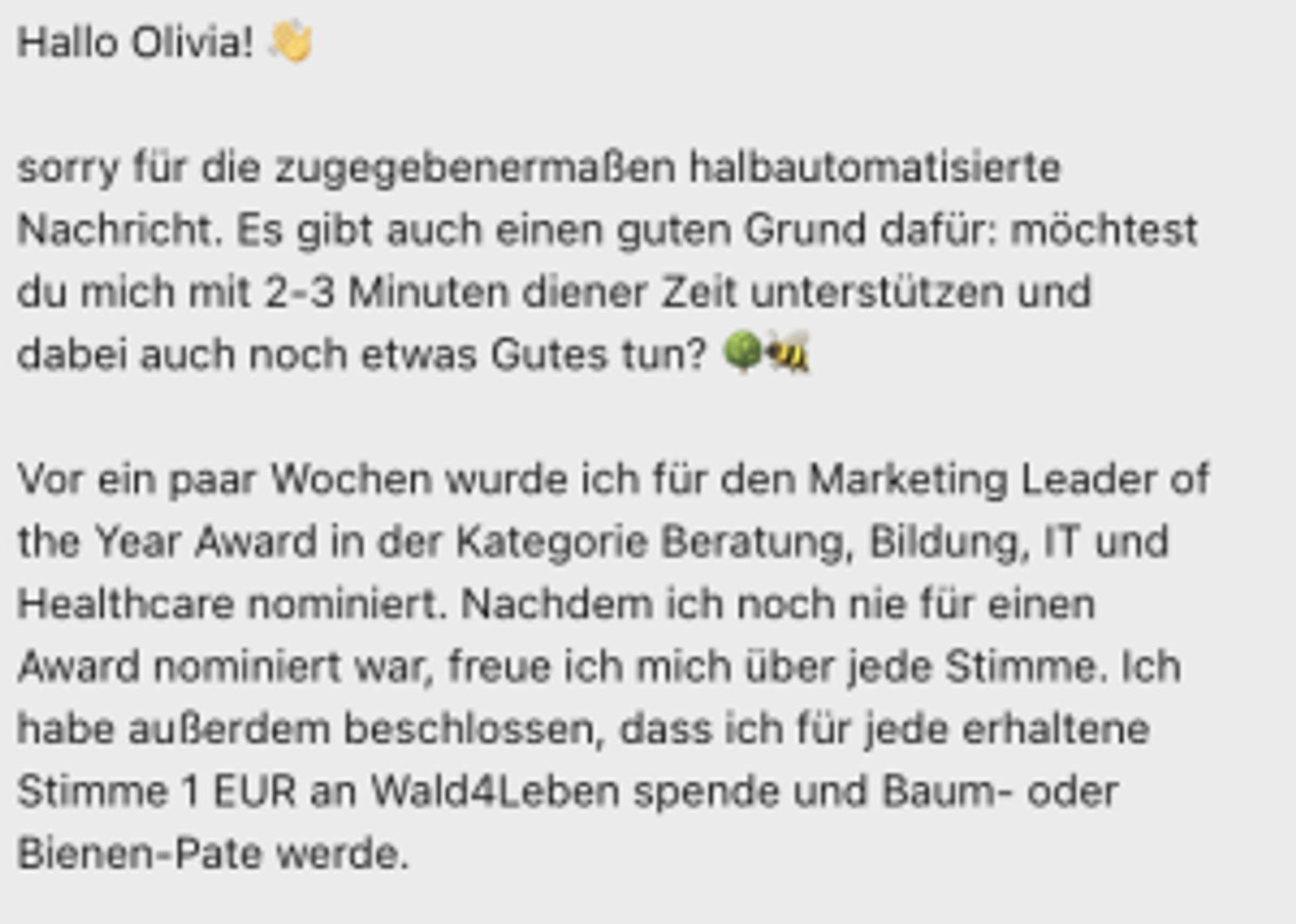
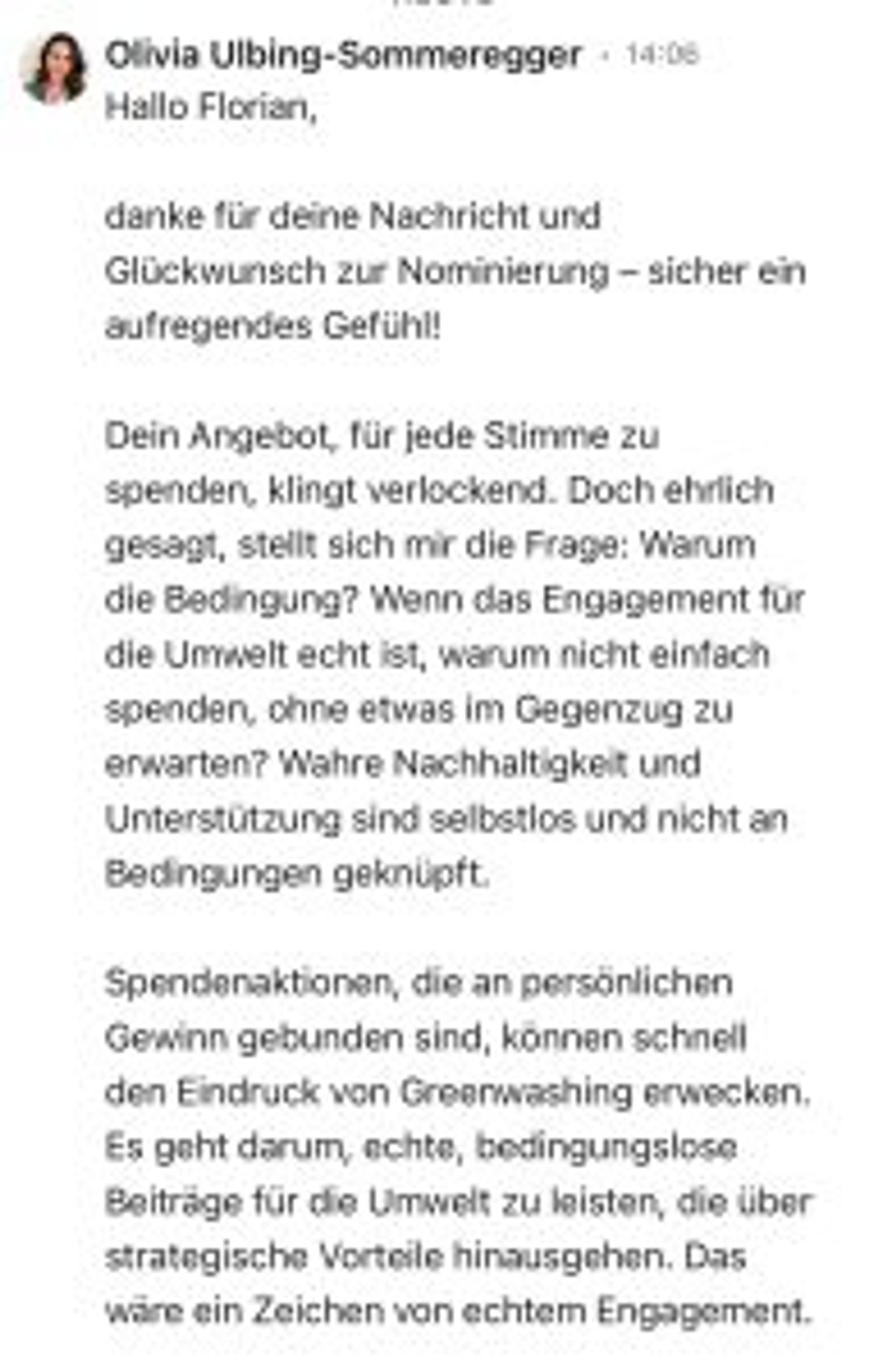
I still find it hard to put into words how much messages like this annoy me. The 2040 climate target isn’t a nice-to-have – it’s essential that we drastically cut our emissions to get global warming under control. To keep ignoring the climate crisis and say that an individual or a company can’t do anything strikes me as simply irresponsible towards the coming generations, to whom we’ll hand over our work, this world. It may sound nice to plant a tree for a vote, but sorry, that trivialises a global problem that takes more than planting a few trees and adopting bees. If the sender had done this with good intentions, that would at least be a start, but as a trade-off I find it almost insulting given the challenge ahead of us.
So my answer wasn’t quite as sweet and nice as his offer sounded.
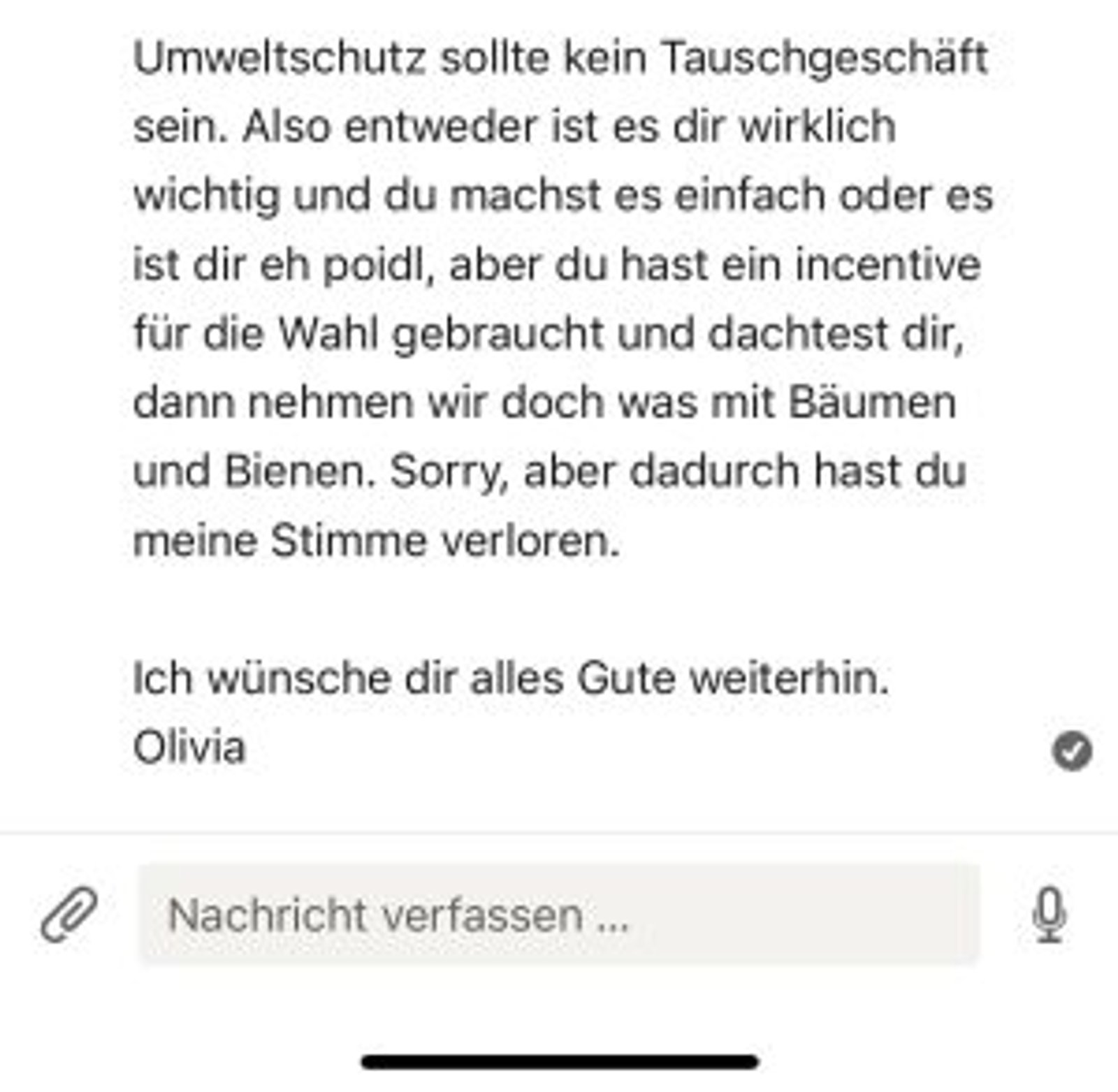
A healthy company on the inside also shines on the outside. Authentic sustainability is the way to hold your own in the market for the long term and be recognised as a responsible company. It’s time every company started thinking about how it currently uses resources, but also what it gives back, because as I said at the start, our own time on this planet is only a fraction of what coming generations should still get to experience.
What is ESG?
ESG stands for environmental, social and governance – three pillars that together form the backbone of truly sustainable corporate management. They show that real sustainability goes beyond recycling paper and has to be deeply embedded in a company’s ethics.
Environmental: This pillar refers to a company’s ecological footprint, including its use of resources and waste production.
Social: This is about the wellbeing of employees and of the community the company affects.
Governance: Governance deals with corporate management, ethics and transparency.
Without really thinking about it, I implemented sustainability at oha! from day 1 & led by example, because somehow I was already aware that this planet’s resources aren’t infinite. And let’s be honest, wouldn’t you also want to build on something that isn’t rotten from the inside? That goes for companies as well as for the environment we live in.
Is oha! a sustainable company?
Let me say this up front – yes and no. Through the insights from the ESG course I’m currently attempting, I realised that oha! already does some things very well, without me having agonised for weeks over what we could do for more sustainability in the company. We’re definitely not yet where I want to be, but I’m already very proud of the foundation we’re building on.
oha! is basically a paperless agency, but since we know our invoices often get printed for accounting, we donate a tree to the Plant for the planet project for every invoice we send. You too can support our reforestation project in Ghana here and donate trees.
We separate our waste strictly and avoid plastic wherever we can. We mainly buy our technical devices second-hand and rely on electric mobility or use public transport with the Klima Ticket. When the weather allows, we also like to cycle to and from the office.
The physical and mental health of my team members is especially important to me. We support that through flexible working hours and the option to work remotely.
Where we still struggle is in assessing the energy resources we use, because our office setup gives us no insight into how much electricity, water or district gas for heating we consume. I also want to find out how much waste in kg we really produce and send for recycling. I’m also trying to find out exactly where our data is hosted and how much energy our work uses there. This consumption is often overlooked at online agencies in particular, but it’s part of the real total. The oha! website, at any rate, does okay on carbon consumption, though with clear potential for improvement. Working on it!
Only once you spend more time on resource management do you notice everything you could and should pay attention to, so my next goal for oha! is to produce a voluntary ESG sustainability report, even though as a small digital studio we wouldn’t be required to report yet.
What can other companies do for sustainability?
A company can only reach its sustainability goals if they’re authentic and deeply anchored in the company culture. Instead of superficial actions, what’s needed is structured measures that create real change.
From 2025, many companies in Europe will be required to submit ESG reports. So it’s smart not to wait until 2025 but to start with sustainable measures now. That strengthens not only your reputation but also your internal structure and the wellbeing of everyone involved.
Sustainability affects not only the environment but also employee satisfaction. A valued employee stays loyal to the company and actively contributes to its success. In a sector with a shortage of skilled workers, this could be the key to winning and keeping top talent.
So is that greenwashing?
A few days ago I got this message on LinkedIn. Sounds like a great deal, doesn’t it?
I still find it hard to put into words how much messages like this annoy me. The 2040 climate target isn’t a nice-to-have – it’s essential that we drastically cut our emissions to get global warming under control. To keep ignoring the climate crisis and say that an individual or a company can’t do anything strikes me as simply irresponsible towards the coming generations, to whom we’ll hand over our work, this world. It may sound nice to plant a tree for a vote, but sorry, that trivialises a global problem that takes more than planting a few trees and adopting bees. If the sender had done this with good intentions, that would at least be a start, but as a trade-off I find it almost insulting given the challenge ahead of us.
So my answer wasn’t quite as sweet and nice as his offer sounded.
A healthy company on the inside also shines on the outside. Authentic sustainability is the way to hold your own in the market for the long term and be recognised as a responsible company. It’s time every company started thinking about how it currently uses resources, but also what it gives back, because as I said at the start, our own time on this planet is only a fraction of what coming generations should still get to experience.
Written by
Olivia Ulbing-Sommeregger
Olivia Ulbing-Sommeregger
Founder & CEO, oha! digital
Olivia Ulbing-Sommeregger is founder and CEO of oha! digital, an agency for social media, performance marketing and AI based in Salzburg. Since 2018 she has been supporting companies across Austria, Germany and Switzerland – from SMEs to brands like Bankhaus Spängler and Miele Professional – with strategy, content and advertising on Meta, TikTok, LinkedIn and Google. She is co-author of the Rheinwerk book “Follow me! Erfolgreiches Social Media Marketing” (7th edition, 2025) and completed the WIFI diploma programme in CSR, ESG and sustainability management. Her standard is straight talk instead of agency blah.
← All Klartext articles
Keep reading
More Klartext
All articles →

Social Media, AI Marketing
•
LinkedIn AI Comments: Your "Exciting post!" is currently disappearing into the feed
LinkedIn is demoting AI-generated comments, while at the same time ChatGPT, Gemini, and others prefer to quote real people from LinkedIn. Anyone still letting a bot comment now is cutting corners in the wrong place.
LinkedIn is demoting AI-generated comments, while at the same time ChatGPT, Gemini, and others prefer to quote real people from LinkedIn. Anyone still letting a bot comment now is cutting corners in the wrong place.
→

Social Media, Performance Marketing
•
Social media ban in Austria: Brussels hits the brakes – your budget doesn't
Brussels postpones Austria's social media ban by a year. This is no all-clear, however, as platforms and the EU KIDS Act have long been working on an age limit.
Brussels postpones Austria's social media ban by a year. This is no all-clear, however, as platforms and the EU KIDS Act have long been working on an age limit.
→

AI, social media
•
Meta Muse Austria: The AI agent no one has (yet) – but everyone should know about
Meta Muse handles marketing tasks in the background, just not here. We break down what's proven, what remains open, and what you can already prepare today.
Meta Muse handles marketing tasks in the background, just not here. We break down what's proven, what remains open, and what you can already prepare today.
→
Ready when you are!
Let’s make your
digital story work.
Tell us briefly what you’re planning.
The first call is on us.
" height="139.48895313719183px" id="Fw0RCnuvL" transform="translate(0.712 0.347)" width="755.8148253984783px"/></svg>)
Imbergstrasse 25
5020 Salzburg

© 2026 oha! digital. All rights reserved
Imbergstrasse 25
5020 Salzburg
© 2026 oha! digital. All rights reserved
Imbergstrasse 25
5020 Salzburg
© 2026 oha! digital. All rights reserved