Sustainability
•
4 min.

by Olivia Ulbing-Sommeregger
![[object Object]](https://framerusercontent.com/images/BrJ4qUY8IgXjkbIGqFlB1mczx5Q.jpg?width=1600&height=902)
What is ESG?
ESG stands for Environmental, Social, and Governance – three pillars that together form the backbone of genuinely sustainable corporate management. They demonstrate that true sustainability goes beyond merely recycling paper and must be deeply embedded in company ethics.
Environmental: This pillar refers to a company’s ecological footprint, including its resource use and waste generation.
Social: This is about the well-being of employees and the community that the company impacts.
Governance: Governance deals with corporate leadership, ethics, and transparency.
Subconsciously, I implemented & exemplified sustainability at oha! right from day 1, because somehow I was already aware that this planet’s resources are not infinite. And let’s be honest, wouldn’t you also wish to build on something that isn’t rotten from the inside out? That applies to companies as well as to the environment in which we live.
Is oha! a sustainable company?
Right off the bat – yes and no. Through insights from the ESG training course I am currently taking, I have realised that oha! is already doing a few things very well, without me spending weeks racking my brain about what we could do for greater sustainability in the company. We are definitely not yet where I would like us to be, but I am already very proud of the foundation we are building on.
oha! is fundamentally a paperless agency, but since we know that our invoices are often printed out, especially for accounting, we donate a tree to the Plant for the Planet project for every invoice sent. You too can support our renaturation project in Ghana here and donate trees.
We separate our waste strictly and avoid plastic wherever possible. We mainly buy our tech devices second-hand and rely on e-mobility or use public transport with the KlimaTicket. When the weather permits, we also like to take the bike to commute to the office and back.
The physical and mental health of my employees is particularly important to me. We achieve this on the one hand through flexible working hours and the option to work remotely.
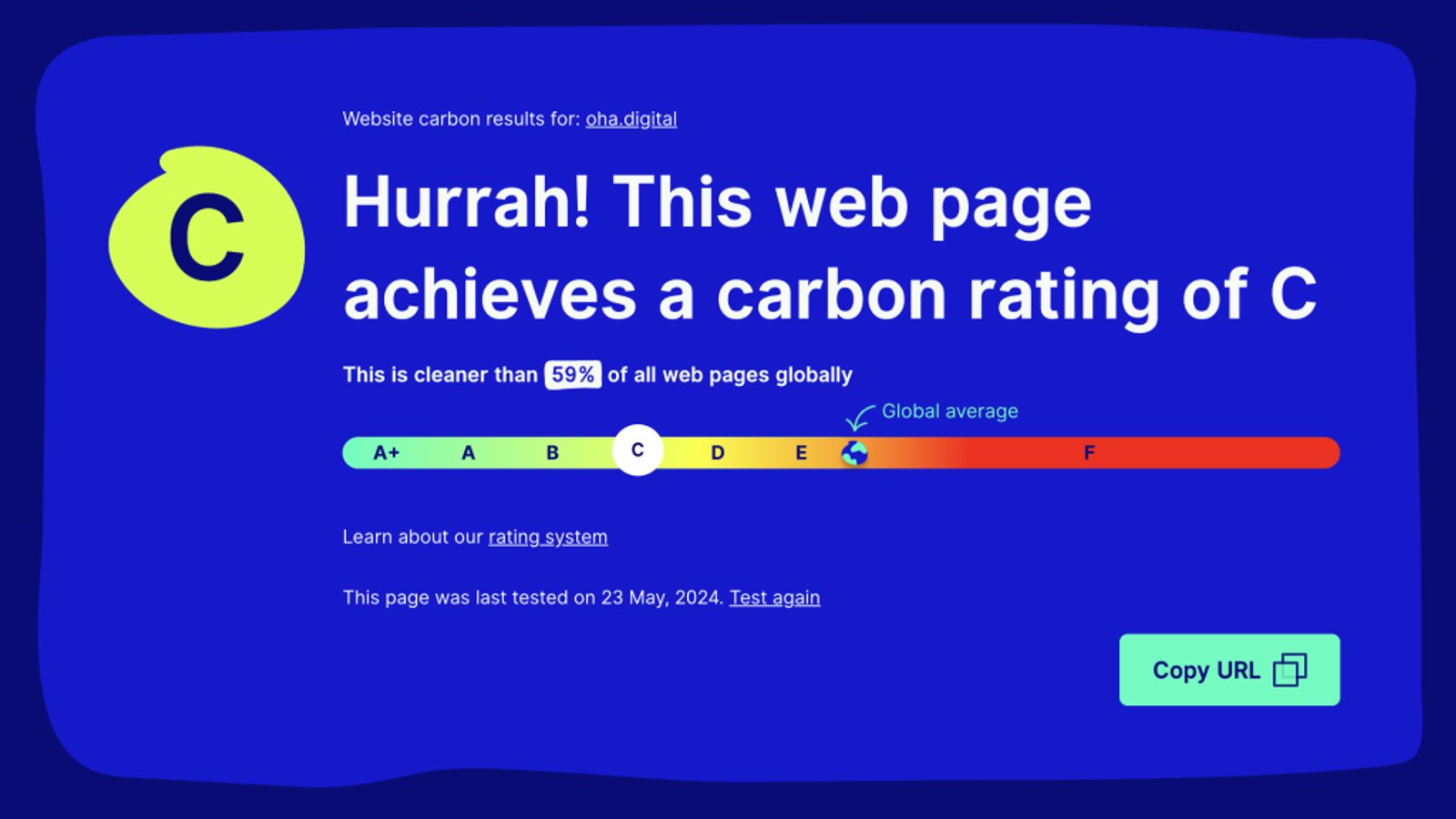
Where we still struggle is in assessing our consumed energy resources, because due to our office setup, we have no visibility into how much electricity, water, or district gas for heating we use. I also want to find out how much waste in kg we actually produce and send for recycling. I am also trying to figure out where exactly our data is hosted on servers and how much energy we consume through our work. This consumption is often overlooked, especially in online agencies, but it is part of the actual footprint. In any case, the oha! website performs okay regarding carbon consumption, albeit with clear potential for improvement. Working on it!
When you delve deeper into the topic of resource management, you only then realise everything you could and should pay attention to; therefore, my next goal for oha! is also the preparation of a voluntary ESG sustainability report, even though, as a small digital studio, we are not yet subject to reporting requirements.
What can other companies do for sustainability?
Every company can only achieve its sustainability goals if these goals are authentic and deeply rooted in corporate culture. Instead of superficial actions, structured measures are required that bring about real change.
From 2025 onwards, many companies in Europe will be obliged to submit ESG reports. It is therefore wise not to wait until 2025, but to start with sustainable measures right now. This not only strengthens reputation, but also the internal structure and the well-being of everyone involved.
Sustainability influences not only the environment, but also employee satisfaction. A valued employee remains loyal to the company and actively contributes to business success. In a sector facing a shortage of skilled workers, this could be the key to attracting and retaining top talent.
Is that greenwashing then?
A few days ago, I received this message on LinkedIn. Sounds like a great deal, doesn’t it?
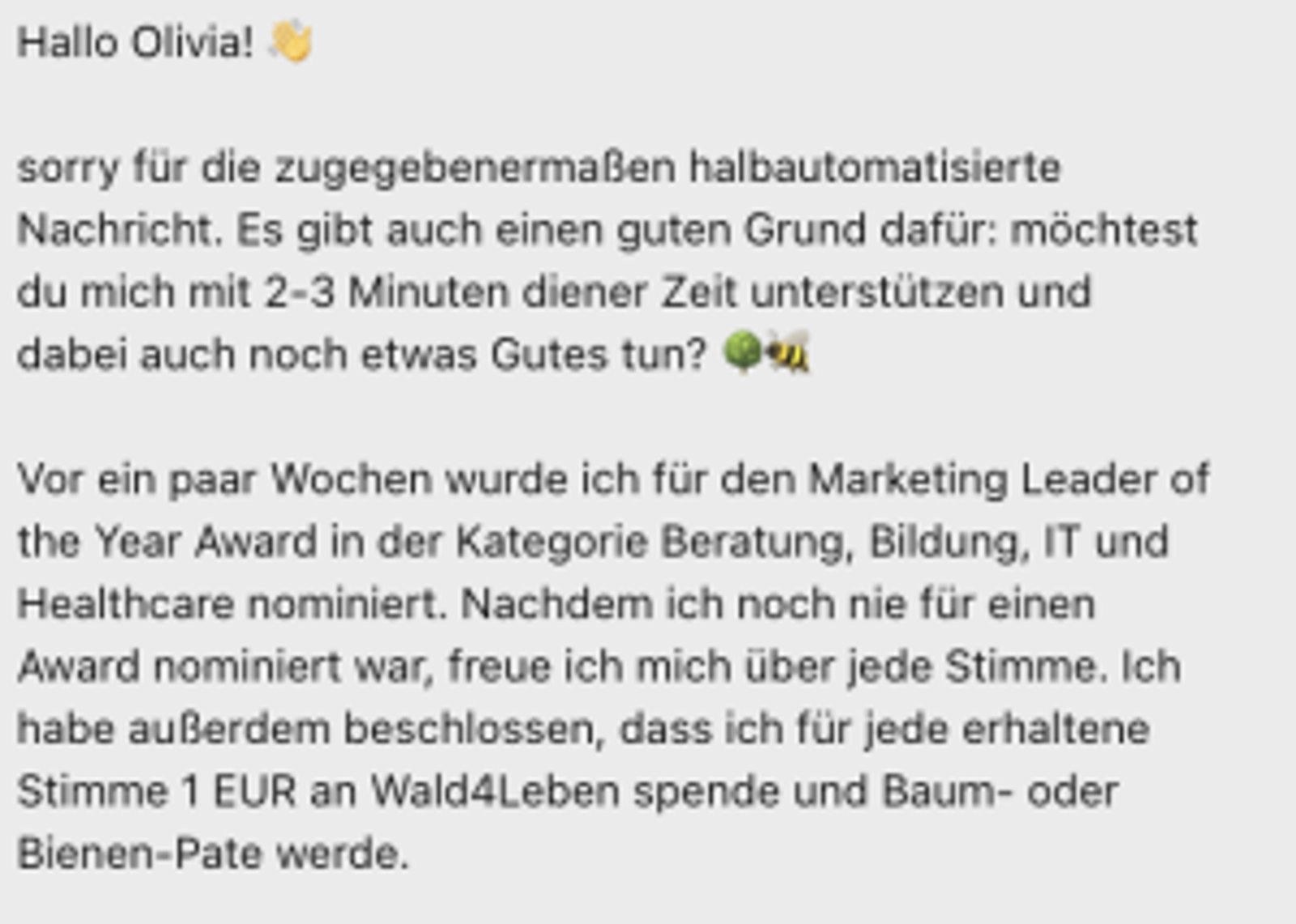
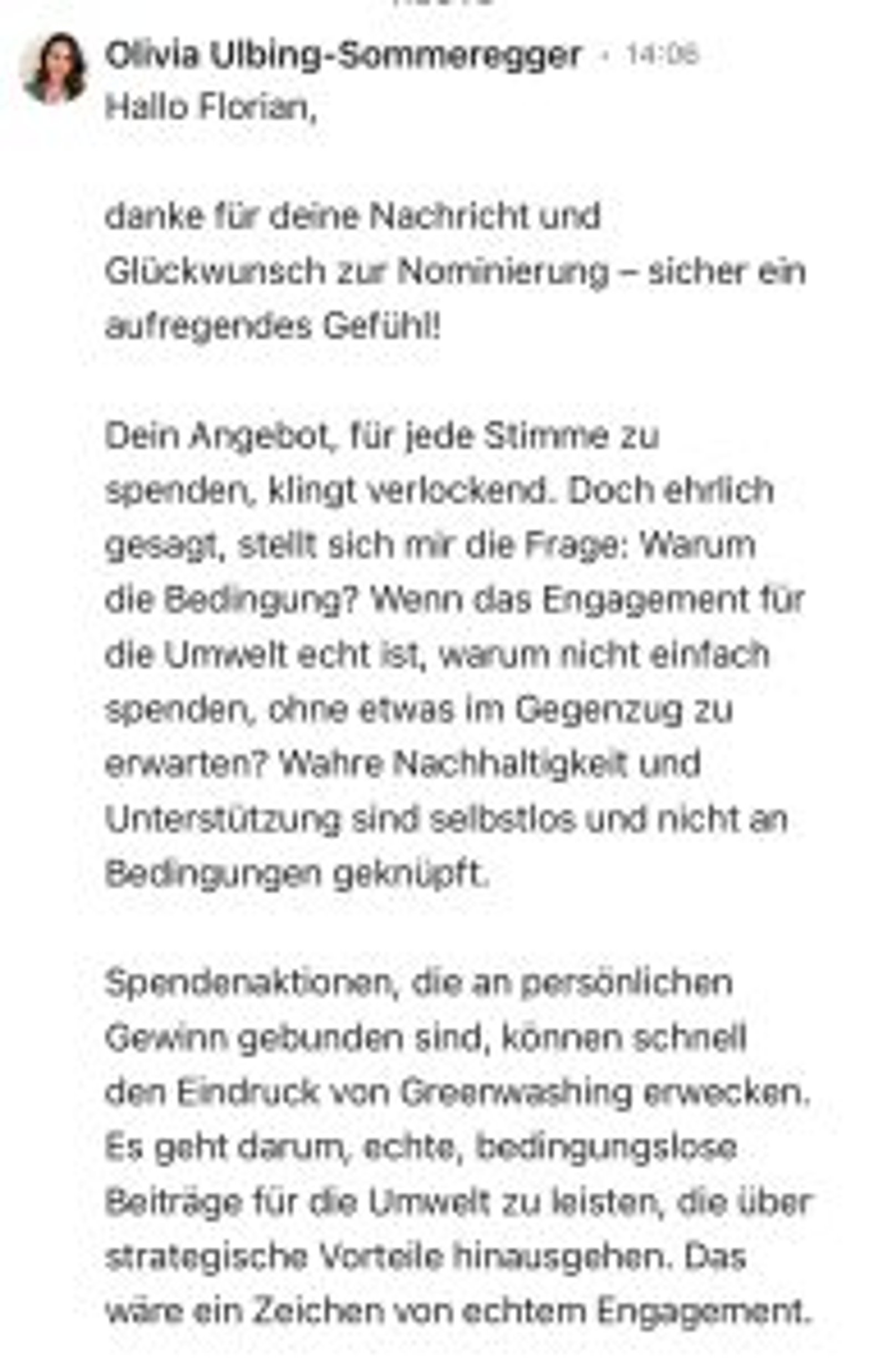
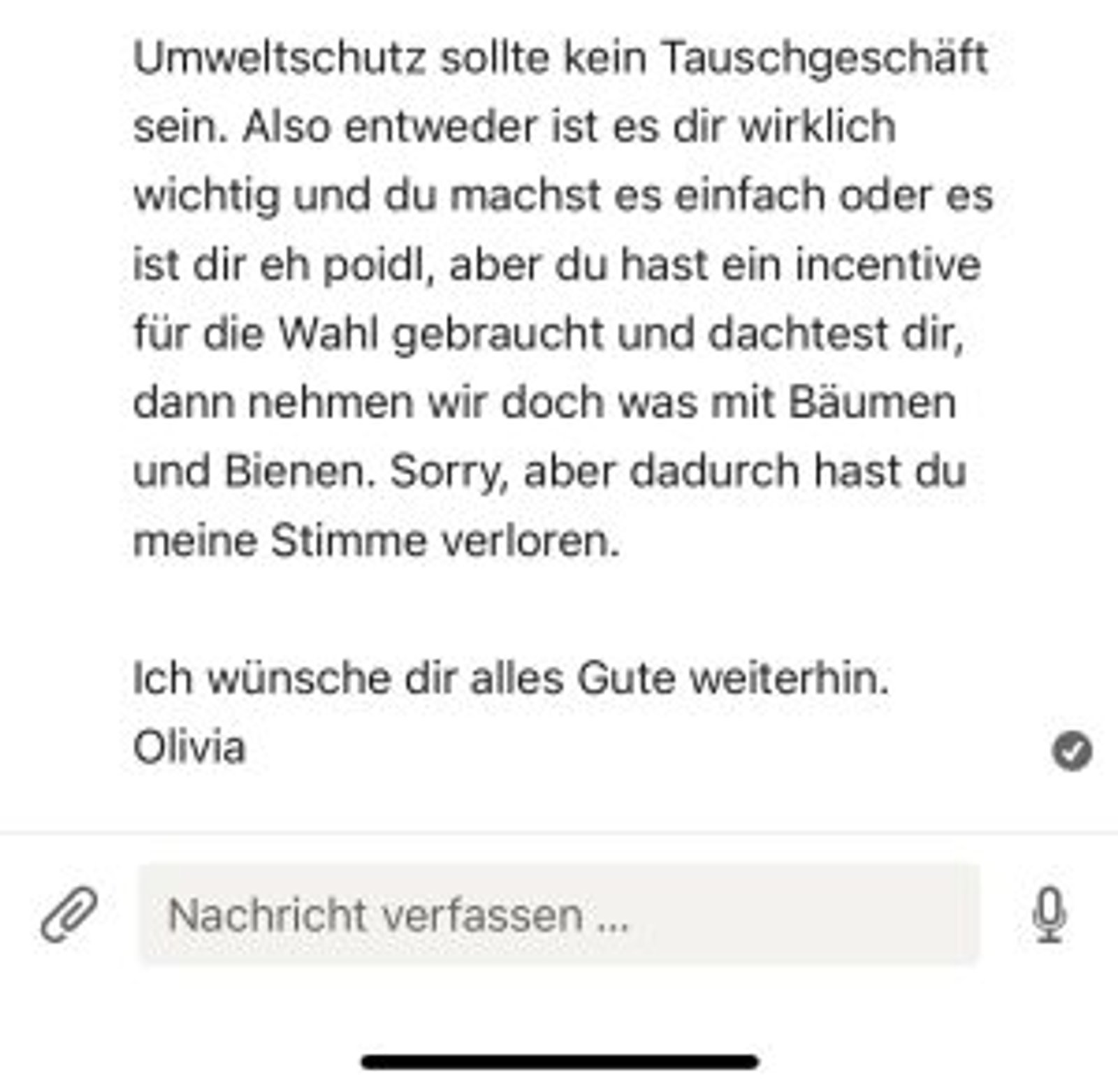
I still find it hard to put into words how much such messages annoy me. The climate target for 2040 is not a nice-to-have – it is essential that we drastically reduce our emissions so that we can get global warming under control. Continuing to pretend that the climate crisis does not exist and that one cannot do anything as an individual or company is, in my view, simply irresponsible towards the coming generations, to whom we will hand over our life’s work, this world. Planting a tree for a vote might sound nice enough, but sorry, that trivialises a global problem that requires more than just planting a few trees and adopting bees. If the sender had done it with good intentions, that would already be a start, but as a quid pro quo, I find it almost insulting given the challenge that lies ahead of us.
Therefore, my reply was not quite as sweet and friendly as his offer sounded.
A healthy company core also shines outward. Authentic sustainability is the way to establish oneself in the market long-term and be recognised as a responsible business. It is high time that every company starts thinking about how their own business currently consumes resources, but also what it gives back, because as mentioned at the beginning, our own time on this planet is only a fraction of what future generations should still be able to experience.
Written by
Founder & CEO, oha! digital
Olivia Ulbing-Sommeregger is the founder and CEO of oha! digital, a Salzburg-based agency specialising in social media, performance marketing and AI. Since 2018, she has been supporting companies across the DACH region – from SMEs to renowned brands such as Bankhaus Spängler and Miele Professional – with strategy, content and advertising on Meta, TikTok, LinkedIn and Google. She is the co-author of the Rheinwerk specialist book "Follow me! Successful Social Media Marketing" (7th edition, 2025) and has completed the WIFI diploma course in CSR, ESG and Sustainability Management. Her standard: plain speaking instead of agency fluff.
← All plain-text posts
Read more
More plain speaking
All posts →


Ready when you are!
Let’s make your
digital story work.
Briefly tell us what you have in mind.
The initial consultation is free of charge.
" height="139.48895313719183px" id="Fw0RCnuvL" transform="translate(0.712 0.347)" width="755.8148253984783px"/></svg>)
