Social Media, Consulting
•
12 mins

by Olivia Ulbing-Sommeregger
![[object Object]](https://framerusercontent.com/images/Jz34NgPPngW6Rms8cczGItsgIA.jpg?width=1600&height=1067)
Short & sweet
As of 27 September 2026 (in Austria via the UWG amendment, BGBl. I No. 58/2026), environmental claims must be substantiated; blanket terms without evidence are prohibited.
The separate "Green Claims Directive" is not coming; it was withdrawn on 20 June 2025 – do not confuse it with the EmpCo Directive.
"Climate neutral" only without sole reliance on compensation; proprietary seals only with genuine certification.
Old social media and blog content does not need to be deleted across the board, but must be reviewed, as it is considered ongoing advertising.
Penalties of up to 4% of annual turnover, plus the risk of warning letters from competitors and consumer protection associations.
The EmpCo Directive applies in Austria from 27 September 2026, which simply put means: from this key date, only what you can prove counts in environmental advertising. Austria implemented the requirements through an amendment to the Federal Act Against Unfair Competition (UWG), adopted by the National Council on 7 July 2026, published as BGBl. I No. 58/2026. From this cut-off date, "sustainable" is no longer just a sentiment to drop into a caption; it is a claim that must be substantiated in case of dispute.
“From 27 September 2026, ‘sustainable’ is no longer just an advertising buzzword. You have to prove your claim.”
— Olivia Ulbing-Sommeregger, Founder of oha! digital
What specifically changes on 27 September 2026?
Two EU initiatives are often confused in media coverage. The separate “Green Claims Directive” intended to introduce mandatory ex-ante verification for environmental claims; it was officially withdrawn by the EU Commission on 20 June 2025 after the EPP group in the European Parliament, in particular, warned of excessive bureaucratic burdens. It will not be coming, not even in a revised form.
The EmpCo Directive (EU) 2024/825 is quite different: it has already been in force since 26 March 2024. Austria had to transpose it into national law by 27 March 2026 and did so via the aforementioned UWG amendment. It applies from 27 September 2026, a Sunday—the first regular working day thereafter is Monday, 28 September. From that point on, prohibited practices include generic terms such as "climate neutral", "environmentally friendly" or "green" without a recognized eco-label, self-created sustainability seals without certification, and climate neutrality claims based entirely on offsetting outside the company's own value chain.
Does this only affect corporations, or your small business too?
The rules apply to business-to-consumer (B2C) communications, regardless of company size. A one-person online shop is subject to the same requirements as a multinational corporation. Purely business-to-business (B2B) communication is generally exempt according to the WKO (Austrian Economic Chamber); however, the exemption does not automatically apply to the entire presence of a B2B company. As soon as the same claim appears on a B2C channel—such as on a public website or on social media—it counts as B2C communication and falls under the new rules. A machine manufacturer that promotes "climate-neutral production" solely in quotes sent to corporate clients is not affected, but as soon as the same line is published on the public corporate website, it is considered a B2C claim.
In the event of violations, businesses face classic cease-and-desist warnings (Abmahnungen) and lawsuits from competitors or consumer protection associations, in addition to administrative fines of up to four percent of annual turnover for intentional, widespread infringements across several EU countries, or up to two million euros if turnover cannot be determined. For an SME, a single successful warning letter can already hit hard; a corporation risks the four percent penalty for systematic greenwashing across multiple markets—and that is precisely why the review is worthwhile for both, differing only in the resources deployed.
One point that is missing from most guides concerns not only brands, but also us as service providers. Under Section 18 of the UWG, a business owner is liable for unlawful acts committed "in the operation of their enterprise" by another person—which explicitly includes commissioned agencies. Anyone who, as an agency, freelancer, or social media manager, actually drafts and publishes an environmental claim regularly bears potential co-liability as an immediate actor as well. For clients and service providers alike, this means approval processes and evidence documentation must be clarified contractually and organizationally before the first "climate neutral" caption goes live.
What can you still say from 27 September 2026, and what is no longer allowed without evidence?
The following overview does not replace a case-by-case legal review, but it shows the direction in which every statement needs to move from 27 September 2026 onwards.
Allowed or prohibited: the quick check
✕ Prohibited without evidence from 27/09/2026 | ✓ Still allowed (with evidence) |
|---|---|
"Climate neutral" / "CO2 neutral" based solely on offsetting outside the company's own value chain | Specific, verified reduction and compensation details, shown transparently |
"Sustainable", "environmentally friendly", "green", "eco" as a blanket claim without proof | The same terms, supported by a recognised eco-label (EU Ecolabel, Austrian Ecolabel, Blue Angel, Nordic Swan) |
Self-created, uncertified sustainability seals and logos | Labels from public authorities or recognized, independent certification systems |
"Climate neutral by 2030" without a publicly accessible, measurable plan | Future targets supported by a published, externally verified implementation roadmap |
Overall sustainability claim based solely on a single product component (e.g. recyclable packaging) | Precise claim referring strictly to that specific product component, without overgeneralisation |
Advertising statutory minimum requirements as a special achievement | Advertising achievements that demonstrably go beyond statutory minimum standards |
When it comes to the "climate neutral" row in the table above, a subtle distinction is worth noting. If the claim relates to a single product, a statement based primarily on offsetting is generally prohibited under the directive. If, on the other hand, the exact same statement relates to the company as a whole rather than a specific product, properly presented offsetting shares are more likely to be permissible. (WKO) "Our company offsets its remaining emissions" is therefore different from "this product is climate neutral", even if both claims are based on the same figures.
Which quality labels can you keep?
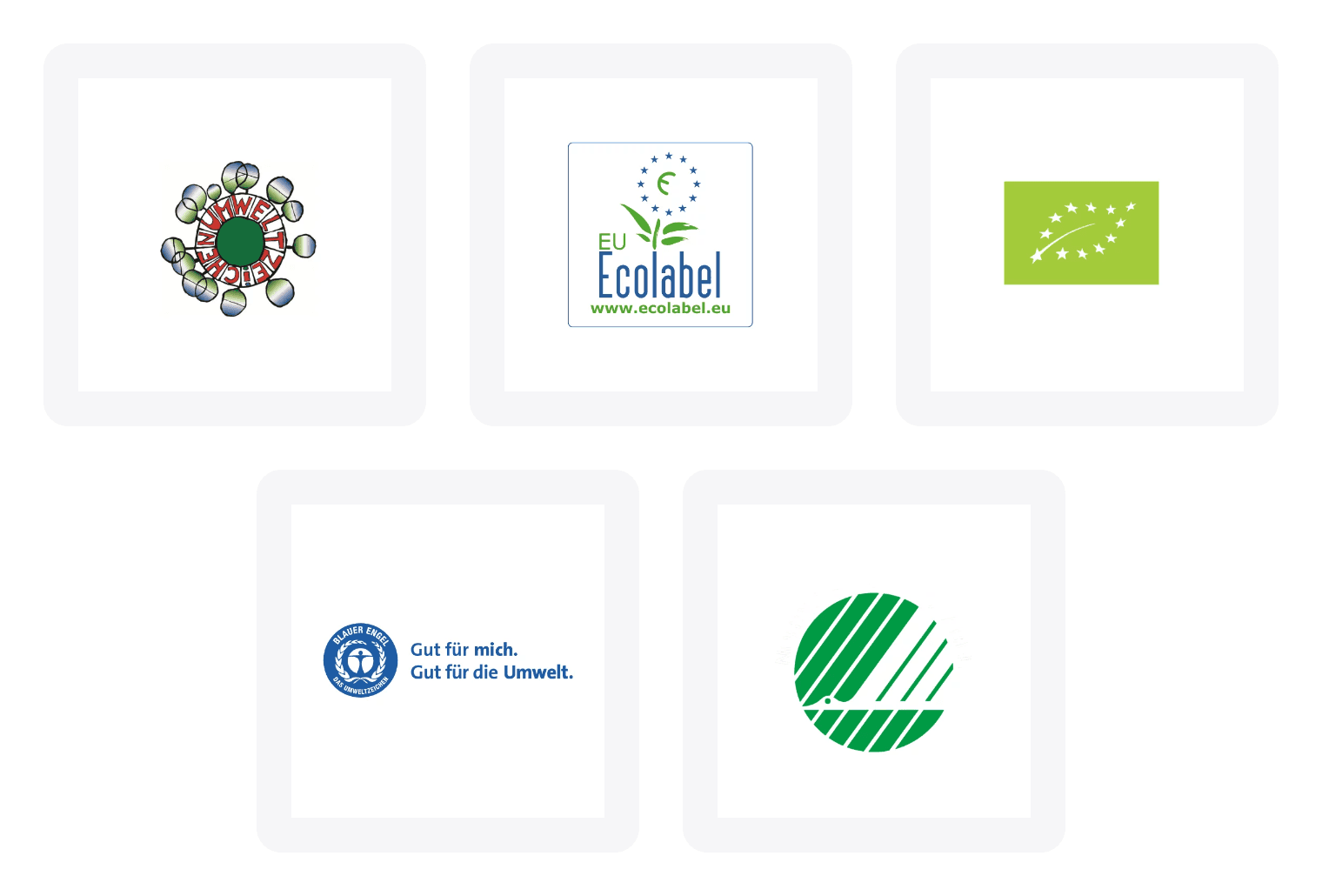
Statutory labels established by public authorities remain valid regardless of the new directive. These include the EU Ecolabel, the Austrian Ecolabel (Österreichisches Umweltzeichen), the Blue Angel, and the EU Organic logo for foodstuffs, as well as national or regional eco-labels compliant with the EN ISO 14024 Type I standard, which covers schemes such as the Nordic Swan. (tww.law, 23/09/2026) For all other seals not awarded by a public body, a four-point test applies: open access on transparent, fair terms for all companies; standard development carried out jointly with experts and stakeholders; a procedure for non-compliance up to the withdrawal of the label; and independent third-party monitoring in line with recognized standards. Fairtrade states that it meets this test via the certification body FLOCERT, which is accredited under ISO 17065. (Fairtrade International) Before continuing to use a seal that is not on this short list, it is well worth checking these exact four criteria, rather than worrying generically that the label is automatically banned.
The background to this tightening is a 2020 study by the European Commission: 344 environmental claims were examined, and in 42 percent of cases there was reason to believe they were false or misleading, while 37 percent were simply too vague. (European Commission, 28 January 2021) A follow-up survey in 2023 yielded even higher numbers: 53.3 percent of the assessed claims were vague, misleading, or unsubstantiated, and around 230 different environmental labels were in circulation across the EU at that time, many of them without independent verification. (European Commission, 22 March 2023) Yes, this was already an issue before the directive; now it is one with genuine legal consequences.
27/09/2026: the EmpCo Directive enters into application in Austria, transposed via the UWG amendment · 53% of environmental claims reviewed in the EU in 2023 were vague, misleading, or unsubstantiated · 230 different environmental labels are currently circulating across the EU, many unverified · 4% of annual turnover: maximum fine for intentional, widespread infringements
Do you now need to delete old social media posts and blog articles?
Short answer: do not delete everything across the board, but review and refine where necessary. The three-year transitional period cited by many guides applies exclusively to products placed on the market before 27 September 2026; civil law claims against this existing inventory are restricted until 2029. (E+H Rechtsanwälte) This grace period does not apply to advertising claims themselves, such as website copy, social media posts, or newsletter wording. An Instagram post from 2024 that remains online is treated as an ongoing commercial practice; from 27 September 2026, it falls under the new rules just like a post published after that date.
In practice, this means that a website and content audit is not a nice-to-have, but the most logical immediate measure. At oha! digital, we currently review this for clients in three steps: identify where claims appear (website, social media channels, newsletter archives, product packaging), assess the risk (blanket claim without any proof versus specific but poorly documented claim), and then either refine it, supplement it with evidence, or in rare cases, remove it altogether.
How do you ensure you don't make any mistakes?
Stocktake across all channels. Website, social media, newsletter archives, packaging, press releases—gather everything that contains environmental claims.
Assign each statement to a category. Substantiated and specific, provable but poorly documented, or generic without any evidence.
Act on category three immediately. Delete it, make it more precise, or underpin it with a recognized label such as the EU Ecolabel or the Austrian Ecolabel.
Secure future commitments. Only leave claims like "climate neutral by 2030" online if backed by a publicly accessible, externally verified implementation plan.
Introduce an approval workflow. Every new environmental statement requires an evidence source before publication from now on.
Do not decide edge cases alone. In cases of legal uncertainty, consult specialized advice; this does not replace tailored legal counsel, but it provides security for everyday content work.
This intersection between the legal framework and content practice is precisely where we offer support at oha! digital in our Online Consulting practice. We are not a law firm and do not provide legal advice in individual cases, but we collaborate closely with specialized partner law firms on complex questions. To keep the most critical points handy, we have compiled the entire checklist as a cheat sheet, free to download after signing up for our newsletter.
Note: This article provides a practical overview based on publicly accessible sources and does not constitute individual legal advice. For a legally binding assessment of your specific phrasing, we recommend consulting a legal advisor or a law firm specializing in competition law.
Let's talk
Not sure if your environmental claims comply with the EmpCo Directive?
Enquire now
→
Frequently Asked Questions
Frequently Asked Questions
From when does the EmpCo Directive apply in Austria?
From 27 September 2026. The associated amendment to the UWG (Federal Act Against Unfair Competition) was passed by the National Council on 7 July 2026 and published as Federal Law Gazette (BGBl.) I No. 58/2026.
What is the difference between the EmpCo Directive and the Green Claims Directive?
The EmpCo Directive (EU) 2024/825 is applicable law and takes effect on 27 September 2026. The separate Green Claims Directive was merely a proposal and was withdrawn by the EU Commission on 20 June 2025; it will not come into force.
Can I still label my product as "climate neutral"?
Only if the claim is not based solely on compensation measures outside the company's own value chain and can be substantiated. Pure offsetting claims without genuine reduction are prohibited from 27 September 2026.
Do I need to delete old social media posts and blog articles?
Not as a rule, but they should be reviewed. The three-year transitional period applies only to products already sold prior to 27 September 2026, not to promotional claims that remain visible online. These are considered ongoing promotional activities and are immediately subject to the new rules.
Does the directive also apply to small enterprises?
Yes. The requirements apply to all B2C communications regardless of enterprise size. Pure B2B communication is generally exempt, unless the same claim also appears on a B2C channel such as a public website or social media.
Which sustainability labels may I continue to use?
Officially established labels such as the EU Ecolabel, the Austrian Ecolabel (Österreichisches Umweltzeichen), the Blue Angel (Blauer Engel), and the EU Organic Logo remain valid, as do EN ISO 14024 Type I ecolabels such as the Nordic Swan. Other labels are permitted if they demonstrate open access, expert standard-setting, a sanctions procedure, and independent third-party verification, as Fairtrade does via the accredited certification body FLOCERT.
What penalties apply for violations of the EmpCo Directive?
In addition to cease-and-desist warnings and lawsuits from competitors or consumer protection associations, intentional, widespread infringements may result in administrative fines of up to 4 percent of annual turnover or up to 2 million euros if the turnover cannot be determined.
Sources
EUR-Lex: Directive (EU) 2024/825 (in force since 26 March 2024, applicable from 27 September 2026)
ts.at Rechtsanwälte: UWG amendment adopted: The EmpCo rules will apply from 27 September 2026 (BGBl. I No. 58/2026)
Austrian Parliament: Amendment against "greenwashing" passes Economic Committee, 24 June 2026
E+H Rechtsanwälte: The end of green arbitrariness
getsunhat.com: Green Claims Directive Withdrawn | EmpCo Rules 2026 (Withdrawal 20 June 2025)
European Commission: Screening of websites for ‘greenwashing’, 28 January 2021 (2020 sweep, 344 environmental claims)
European Commission: Questions and Answers, 22 March 2023 (53.3% / 230 environmental labels)
activeMind.legal: Implementation of EmpCo in the UWG (penalty framework)
JUSLINE Austria: Section 18 UWG (Liability for acts in the course of a business enterprise)
WKO: Environmental advertising and unfair competition (B2B/B2C distinction, climate neutrality at product vs. company level)
tww.law: Sustainability labels: Why self-designed eco-labels are prohibited, 23 September 2026
Fairtrade International: Fairtrade and the EU Consumer Rights Directive (EmpCo)
Written by
Founder & CEO, oha! digital
Olivia Ulbing-Sommeregger is the founder and CEO of oha! digital, a Salzburg-based agency specialising in social media, performance marketing and AI. Since 2018, she has been supporting companies across the DACH region – from SMEs to renowned brands such as Bankhaus Spängler and Miele Professional – with strategy, content and advertising on Meta, TikTok, LinkedIn and Google. She is the co-author of the Rheinwerk specialist book "Follow me! Successful Social Media Marketing" (7th edition, 2025) and has completed the WIFI diploma course in CSR, ESG and Sustainability Management. Her standard: plain speaking instead of agency fluff.
← All plain-text posts
Read more
More plain speaking
All posts →


Ready when you are!
Let’s make your
digital story work.
Briefly tell us what you have in mind.
The initial consultation is free of charge.
" height="139.48895313719183px" id="Fw0RCnuvL" transform="translate(0.712 0.347)" width="755.8148253984783px"/></svg>)
